
Training › For care providers › Safety and mobility
SERVICE PROVIDER · LESSON 2 OF 2
The Drive and the Door-to-Door Handoff
Drive in a way a more fragile body can tolerate. Walk the older adult to the actual door of where they are going. Cancel the ride when the right answer is to cancel.
The transfer in went smoothly. The walker is secured. Mr Khalil is buckled in with his cane on the floor and a knit blanket across his lap. The dialysis clinic is a fifteen-minute drive. After this lesson, you can drive in a way his body can tolerate, walk him from the parking lot to the actual treatment room door, and recognize when the right answer is to cancel the ride and reschedule through the right path.
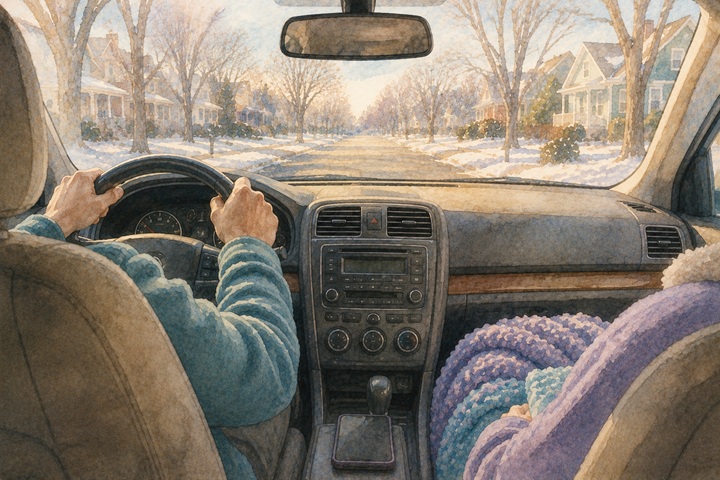
Driving in a way a more fragile body can tolerate
The driving habits that move a body in its forties are wrong for a body in its eighties. Adjust without telegraphing that you are adjusting.
- Gentle starts and stops. Smooth acceleration from a stop. No tap-and-go. Brake earlier and softer than you would alone. Hard stops jerk older necks and shoulders in ways that hurt for hours.
- Wider turns. A sharp turn slides an older body across the seat. Take corners on the wider arc. The seatbelt will catch a slide, but it should not have to.
- Longer following distance. Doubled, at minimum. You need more reaction time so that the brake is gentle when it comes.
- Speed bumps and potholes. Slow to a near-crawl. Older spines feel a bump twice: once on the way down and once on the way up.
- Cabin temperature. Re-check halfway through the drive. A blanket on the lap that was fine at the start can become too warm; a vent angled at a window can become too cold.
What not to do. Do not turn the music up. Do not phone-call hands-free with a friend. Do not run yellow lights to make a green. The cabin is the older adult's space for these fifteen minutes. Calm and quiet is the service.
Conversation during the drive
- Some older adults will want to talk. Some will want quiet. Follow their lead. Do not fill silence.
- If they want to talk, listen. Do not turn your head to look at them while driving; eyes on the road. A nod and a "yes" or a "tell me more" is enough.
- Do not ask about medical conditions, family situations, or money. If they offer, that is different.
- Do not give advice on anything in the home, the family, or their care plan. That is the advocate's job.
- If they doze off, leave them. The dialysis chair is harder if they are tense from the ride.
The door-to-door handoff
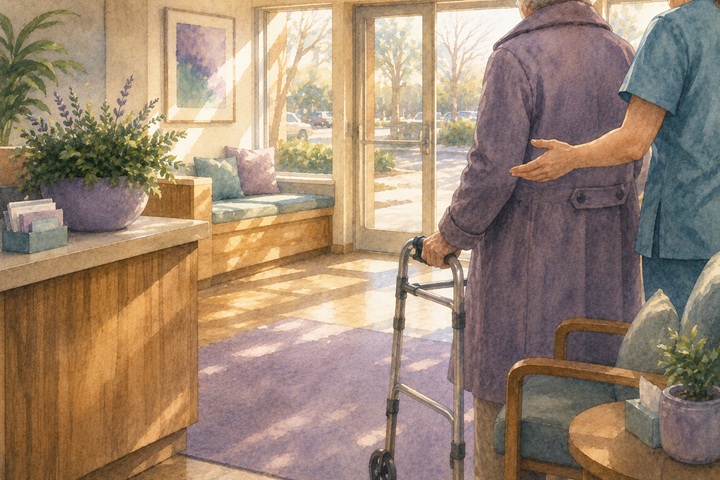
This is the part most drivers cut short. The ride is not over at the curb. The ride is over at the door of the room the older adult is walking into.
- Park where the walker will work. Not at the kerb cut twenty feet away. Look for accessible parking; ask the clinic if you can use a drop-off zone closer to the door.
- Walk with them, not ahead of them. Match their pace. The slower person sets the speed.
- Through the door, into the building. Not just to the door. The door is a step on the way in, not the destination.
- To the receiving person. A clinic nurse, the receptionist, a family member who is meeting them. Confirm the handoff out loud: "Mr Khalil is here for his dialysis appointment." Wait for the receiving person to acknowledge.
- Hand back the walker if they want to keep it through the appointment, or fold it and leave it at reception if the clinic has its own. Ask, do not assume.
- Then back to the car. The booking is "completed" when the older adult is in the room and the receiving person has them, not when the older adult is out of the car.
When to cancel a ride
Some rides should not happen. Recognizing this is part of the work.
- Weather. Ice, heavy snow, hard rain that exceeds the car's traction or your visibility. Cancel and reschedule. Older bodies cannot absorb a slide.
- The vehicle. A flat tire, a warning light you do not understand, a heater that will not warm in winter or a/c that will not cool in summer. Do not push through.
- The older adult's condition. They open the door and they are pale, sweating, confused, or unsteady in a way that is new. This is not a ride to start; this may be a 911 call or a same-day message to the family and the advocate.
- You. You are unwell, you did not sleep, you are off in a way that affects driving. Cancel through the right path. Your judgment in the car is part of the safety of the ride.
The right path is: a same-day in-app message to the family before the scheduled time, a same-day in-app message to your iCaria advocate, and the cancellation in the booking. The advocate handles the family if the family is upset.
Key takeaways for Lesson 2
- Drive for a more fragile body: gentle starts and stops, wider turns, longer following distance, slow over bumps.
- Follow the older adult's lead on conversation. Calm and quiet is the service. Eyes on the road.
- Door-to-door means walking them into the building and confirming the handoff to a receiving person.
- Cancel the ride when weather, the vehicle, the older adult's condition, or your own state make it unsafe. Message family and advocate same-day.
- A short knowledge test follows, and you re-take it each year when you renew your certification.
Finding this again Open Training from your portal any time to come back to this module. A knowledge quiz follows, and you re-take it each year when you renew your certification.