
Training › For care providers › Safety and mobility
SERVICE PROVIDER
Infection Control and Basic Hygiene
Hand hygiene, personal protective equipment, and simple habits that keep vulnerable people safe. The home is not a hospital, and the work is not about looking sterile. It is about not bringing things in, and not leaving things behind.
After this module, you can walk into Maria's apartment in East Houston on your next visit and protect her without making the visit feel clinical. You wash your hands at the moments that matter. You wear gloves and a mask only when the moment calls for them, and you take them off the right way. You leave the home cleaner than you found it. You stay home when you are unwell and tell the family and iCaria in time for them to find cover. Older adults are at higher risk from common infections, and the home should be the one place they are safest.

Why this matters
Common infections that pass quickly through younger adults can be serious in an older adult. A bad cold can land Mrs Diallo in the hospital. A stomach bug can dehydrate Mr Khalil overnight. Your hands and your habits are part of how that does not happen.
The goal is not hospital-clean. The goal is the right habit at the right moment.
The five moments for hand washing
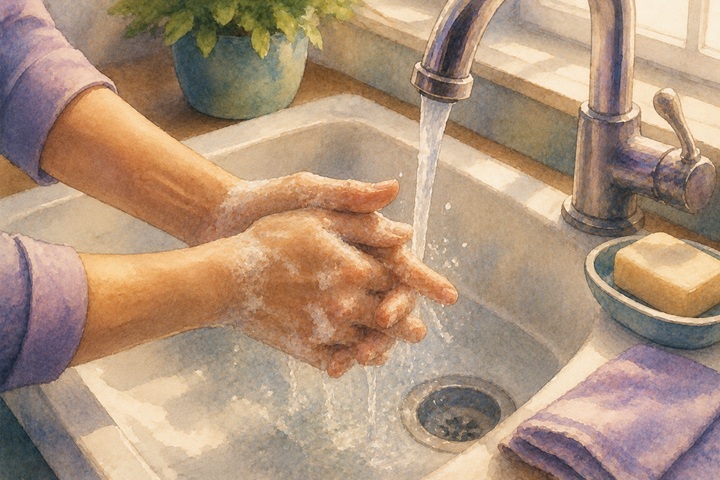
Most providers wash their hands when they arrive and when they leave. That covers two of the five moments. The other three matter just as much.
- Arriving. Before you touch anything in the home, wash. The germs you brought from the bus and the door handle stop here.
- Before food prep. Before you handle anything that will go in the older adult's mouth. Soap, twenty seconds, dry on a clean towel.
- After toilet help. Even if you wore gloves. Gloves are not a substitute. Wash after taking them off.
- After touching surfaces a sick person used. A tissue. A used cup. The handle of a thermometer. Wash before you touch anything fresh.
- Leaving. Before you walk out the door. The germs you might have picked up in the home stop here.
Use soap and warm water for twenty seconds when you can. Hand sanitizer (alcohol-based) is fine between hand washes but not a replacement for the soap-and-water moments.
The twenty-second rule. Hum "Happy Birthday" twice. Or count "one alligator, two alligator" up to ten. Most providers wash for half the time they think they do. Time it once and you will see.
Gloves: when, and when not
Gloves protect against contact with body fluids and broken skin. They do not protect against the air. They do not replace hand washing. They are useful in the right moment, and they spread germs around when worn through the whole visit.
- Wear gloves when: helping with the toilet or bathing, cleaning a wound, handling soiled linens, cleaning up vomit or other bodily fluids, cleaning a contaminated surface.
- Do not wear gloves when: preparing food, helping with eating, hand-feeding, doing household tasks like vacuuming or making the bed (unless the bed has just been used by someone unwell).
- Change gloves between tasks. The same pair from toilet help to lunch prep is worse than no gloves at all.
- Take gloves off without touching the outside. Pinch the cuff of one glove with the other gloved hand, peel it off inside out, hold it in your bare hand, slide the bare hand inside the cuff of the second glove, peel that one off over the first, throw both in the trash. Then wash your hands.
Masks: when, and how
A mask protects the air between you and the older adult. Wear one when the moment calls for it.
- You have a cough or runny nose but you have decided you are well enough to work. Mask up at the door, stay masked the whole visit.
- The older adult is unwell. A respiratory illness, a recent surgery, a known weakened immune system. Mask up.
- The family asks. A family may have its own reasons. Mask up. No discussion.
- Replace the mask when it gets damp. A damp mask is less effective than a fresh one. Carry a spare.
- Do not pull the mask down to talk and then pull it back up. If you are masking, mask through the whole conversation. The act of touching the mask itself spreads what is on your hands.
Cleaning the common surfaces
At the end of a visit where someone in the home is unwell, do a five-minute surface wipe before you leave. Use whatever cleaning product the family keeps in the home. The product matters less than the surfaces.
- Door handles. Front door, bathroom door, kitchen door, bedroom door.
- Light switches. Every room the unwell person passes through.
- Faucet handles. Kitchen sink, bathroom sink. Both hot and cold.
- The toilet flush handle. The whole top of the toilet tank and the seat.
- The TV remote, the phone, the lamp switches by the bed. The things the unwell person actually touches most.
Skip the deep clean. You are not cleaning the apartment. You are cleaning the touch points. Five minutes, the surfaces above, done.
When you are the one who is unwell
The hardest call you make in this work. You woke up with a scratchy throat. You are scheduled at Maria's in two hours. What do you do?
- If you have a fever, vomiting, diarrhea, or active diarrhea-causing symptoms: stay home. Call iCaria as early as you can so a replacement can be found.
- If you have a cough or congestion but feel well enough to work: tell the family before you arrive. Ask if they would prefer you mask up or if they would prefer to reschedule. Follow their lead.
- If you only feel "off": trust the feeling. A morning of rest is cheaper than a chain of cancellations later in the week.
- Cancellations matter for your iCaria Certified standing, but illness cancellations are exactly what they are for. The standing protects the families. Cancelling because you are sick protects them too.

Key takeaways
- Wash your hands at the five moments: arriving, before food prep, after toilet help, after touching surfaces a sick person used, leaving.
- Gloves are for body-fluid contact and cleaning. Not for the whole visit. Change between tasks. Take them off without touching the outside.
- Mask when you have a cough, when the older adult is unwell, or when the family asks. Replace when damp. Do not touch the mask through the visit.
- At the end of a visit with an unwell person, five-minute wipe of the high-touch surfaces: handles, switches, faucets, remote, phone.
- If you are unwell with a fever or stomach symptoms, stay home and call iCaria early. The standing system protects families, not punishes you.
Finding this again Open Training from your portal any time to come back to this module. A knowledge quiz follows, and you re-take it each year when you renew your certification.