
Training › For care providers › Health awareness
SERVICE PROVIDER
Medication Awareness for Support Workers
You are not a nurse. You are the steady person who notices what is in the organizer, what is not, and where the line is between helping and crossing it.
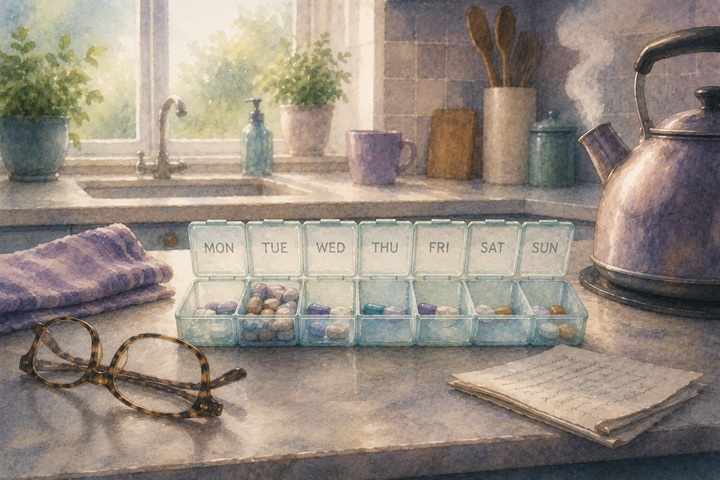
This module is one short lesson and a companion video. The line at the heart of it is short: remind, observe, note. Never administer. Everything else in the module is the human shape of that line, in the kitchens and living rooms where you actually work.
What you may do, and what you must never do
The line between reminding and administering is not paperwork. It is a safety line. Crossing it puts the older adult at risk and puts you at risk of being responsible for a clinical decision that is not yours to make.
What you may do
- Remind. "Sylvie, your morning pills are on the counter." That is reminding.
- Point. Show her the slot. Show her the cup. Show her the glass of water. Your finger is allowed; your hand on the pills is not.
- Observe. Notice what slot is full, what slot is empty, whether she has taken anything this morning.
- Note. Write what you observed in the iCaria app at the end of the visit. Factual sentences. No clinical claims.
- Hand her a glass of water if she asks for water. The water is yours to hand over; the pills are not.
What you must never do without a nurse's directive
- Administer. Do not pick up the pill. Do not put it in her hand. Do not put it in her mouth.
- Dispense. Do not fill the organizer. The family or a pharmacy or a nurse fills the organizer. Not you.
- Change a dose. Not a half. Not a double. Not a skip. Not even if she or a family member says it is fine.
- Substitute. Do not swap a pill for one that "looks the same" from another bottle.
- Crush, split, or hide a pill in food unless a nurse has written a directive that says exactly that.
The bright line is "no nurse's directive, no administration." If a nurse on the family's care team has written a clear directive (signed, dated, specific) that you are to assist with administration, follow it exactly. Without that, the answer is always reminding, never administering.
Reading a pill organizer or schedule
The seven-compartment weekly organizer is one of the most common medication tools you will see. The four-compartment morning/noon/evening/bedtime version is also common. Both are designed so that anyone, including the older adult themselves, can see what has and has not been taken.
You read the organizer with your eyes, not your hands. What to look for:
- Is today's slot empty or full?
- Is yesterday's slot still full?
- Has more than one day's worth been left in earlier in the week?
- Does the count of pills in today's slot match what you remember from previous visits, or has the family added or removed something?

What you do when a slot is still full from a previous day:
- Do not move the pills.
- Do not throw them away.
- Mention it to Sylvie in a calm voice. "Sylvie, Tuesday's slot is still full. Today is Wednesday."
- Write what you saw in the iCaria app at the end of the visit.
- If this is the second or third missed day in a week, send a same-day advocate message.
The side effects to flag the same day
You will not be told the names of Sylvie's medications, and you do not need to know them to do this part well. What you watch for is changes in her, not in the bottle.
Same-day advocate message when you see:
- New confusion that was not there at your last visit.
- Severe drowsiness, slurred speech, or trouble staying awake.
- A new unsteadiness or stumble that suggests a fall risk this hour.
- A change in breathing (faster, slower, harder than usual).
- A new rash, swelling of the face or throat, or hives.
- Vomiting that is new today, especially with any of the above.
You are noticing, not diagnosing. Your note never reads "she is having a reaction to the new pill." It reads "she is unsteady today, her speech is slow, her face looks flushed, and her balance is off compared to last Tuesday." The advocate and the care team take it from there.
When the family asks you to administer
This happens. Sylvie's son hands you the pill and says "she trusts you, just give it to her this once, I am running late." The family is not trying to set you up. They are tired. They are doing their best. The answer is still no.
How to decline kindly:
- "I can remind her, but I cannot put the pill in her hand. Let me show her the slot and pour her a glass of water."
- "I am not allowed to give medication. It is not safe for her, and the rule is the same for every helper. I can sit with her while she takes it herself."
- "If you would like a different arrangement, your iCaria advocate can help find a nurse who can come in for the medication piece."
You do not have to apologize. You are doing the right thing. The line protects Sylvie. The line also protects you.
The line into safeguarding
Most medication situations are about reminding and noting. Some cross into something more serious, and the safeguarding pathway opens. Send the same-day advocate message when you see any of these.
- A household contact appears to be withholding medication from Sylvie on purpose.
- A household contact appears to be taking Sylvie's medication for themselves.
- Sylvie tells you she is afraid to take her pills, or that someone is forcing her to take more than the bottle says.
- You see pills mixed into food without a nurse's directive, in a way that suggests they are being hidden from her.
- Sylvie's medication has changed dramatically since your last visit, and no one in the family seems to know why.
Your job is to send the message factually. The advocate and the safeguarding team decide what happens next. You do not investigate. You do not confront the family member. You do not stay in a situation that feels unsafe.
How to write the note for the family
Your note belongs inside the iCaria app, attached to the booking. Three short sentences is enough.
- What you observed in the organizer (which slots were full, which were empty).
- What you said to Sylvie about it, and what she said back.
- Any change in her you noticed (her balance, her speech, her color, her mood) compared to your last visit.
Less good notes assume the cause.
- "The new blue pill is making her dizzy."
- "She is not taking her pills on purpose."
- "Her son is hiding her medication."
You can see the difference. Observation belongs to you. Diagnosis and motive belong somewhere else.

The closing thought
The line between reminding and administering can feel restrictive. It is not. It is the line that lets you walk into Sylvie's apartment every Wednesday without becoming responsible for a decision that is bigger than your role. Holding the line, kindly and clearly, is one of the most professional things you do. The whole care team relies on you holding it.
Key takeaways
- Remind, point, observe, note. Never administer, dispense, change a dose, or hide a pill in food without a nurse's directive.
- Read the pill organizer with your eyes, not your hands. A missed slot is information, not a problem to fix.
- Same-day advocate message for new confusion, severe drowsiness, slurred speech, breathing change, rash or swelling, or new vomiting.
- Decline a family request to administer kindly: "I can remind, I cannot give. Let me show her the slot." Redirect to the advocate if the family needs a different arrangement.
- Send the safeguarding-path advocate message the same day if you suspect withholding, theft, forced dosing, or hidden pills.
Finding this again Open Training from your portal any time to come back to this module. It is one short lesson plus a short companion video and a knowledge quiz, and you re-take the quiz each year when you renew your certification. This module becomes required at your next annual renewal after publication.