
Training › For families › Staying safe at home
FAMILY · LESSON 2 OF 2
Fall Prevention at Home: Bathrooms, Stairs, and Entryways
If Lesson 1 was the rooms where your parent rests, this lesson is the three places where most home falls actually happen: the bathroom, the stairs, and the front door. The risks are higher here, and so is the value of getting them right.
Welcome back. In Lesson 1 you walked the living areas and bedrooms and made a short list of small fixes. This lesson covers the harder places. Wet floors, narrow stairs, and a high step at the front door ask more of a body that has slowed down a little. The good news is that the most effective fixes here are still simple and still affordable. A grab bar, a non-slip mat, a strip of bright tape on a step edge. None of these is a renovation.
Walk it the same way. As in Lesson 1, do this with your parent and on a calm afternoon. Stand in the bathroom and picture the whole sequence: stepping in, sitting, standing, drying off, reaching the towel. Walk the stairs slowly, both directions. Stand at the front door and picture coming in with a bag of groceries in the rain. The risks show themselves once you slow down and imagine the real moment.
The bathroom, where wet meets hard
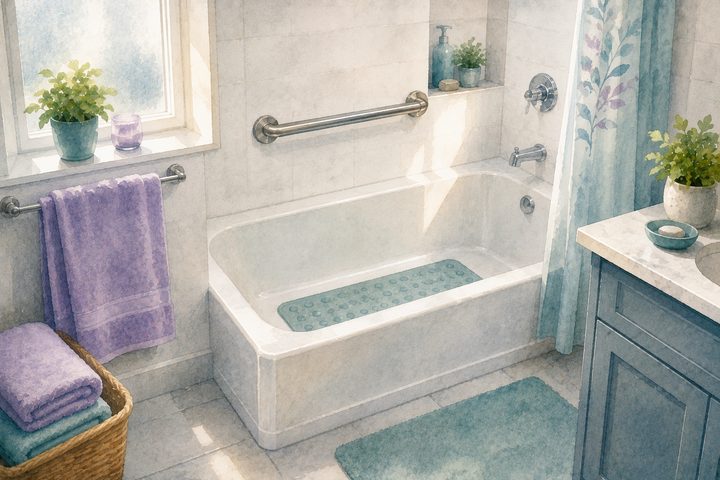
The bathroom is small, the surfaces are hard, and water makes everything slick. It is the room where a fall is most likely and where the right fixes help the most.
Grab bars in the right places
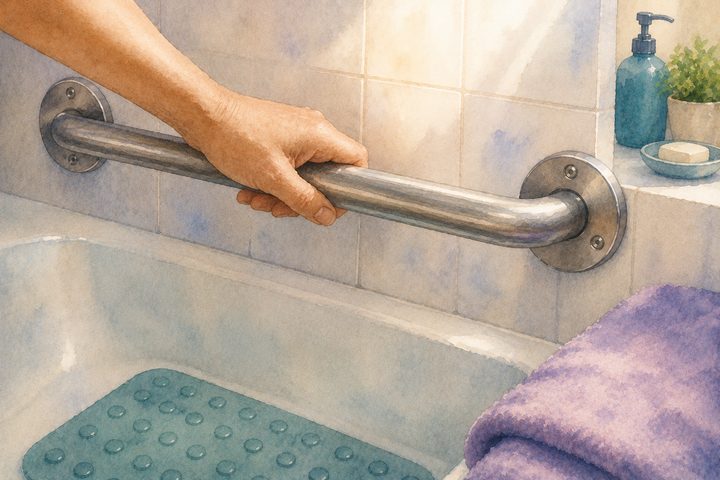
A grab bar gives your parent something solid to hold when they step into the tub, lower themselves to the toilet, or stand up again. The two most useful spots are beside the toilet and inside or beside the bath or shower. A grab bar must be screwed into the wall studs by someone who can fix it properly. A towel rail or a suction handle is not a grab bar and will not hold a person's weight. This is one fix worth doing right.
Non-slip surfaces
Put a non-slip mat or adhesive strips on the floor of the tub or shower, where the surface is most slippery. A second non-slip bath mat on the floor outside the tub catches the drips. Skip a loose, fluffy bath mat that slides, the same rule as the rugs in Lesson 1.
A seat and a reachable towel
Standing for a whole shower is tiring, and tired legs wobble. A simple shower stool or a bath seat lets your parent sit while they wash. Keep soap, shampoo, and the towel within easy reach so they never have to stretch or twist on a wet floor. A raised toilet seat can also make sitting and standing far easier on the knees.
The stairs, up and down
Stairs are unforgiving, and a fall on them is more serious than a fall on the flat. Most stair falls come from three things you can change: a missing handrail, poor light, and a step edge that is hard to see.
A handrail on both sides
A firm handrail your parent can grip the whole way up and down is the single most important thing on a staircase. One rail is good. A rail on both sides is better, because it gives a steady hold whether they are going up or coming down, and whichever hand is stronger. Check that the rail is tight and does not wobble. A loose rail is worse than none, because it gives false confidence.
Light at the top and bottom
There should be a light switch at both the top and the bottom of the stairs, so your parent never climbs or descends in the dark. If the stairwell is dim, a brighter bulb or a small light at each end makes the edges of the steps easy to see.
See the edge of every step
Falls happen when someone misjudges where a step ends. A strip of bright, non-slip tape along the front edge of each step makes the edge stand out. Clear the stairs of anything left there to "take up later," a basket, a folded blanket, a pair of shoes. Stairs are never storage.
When the stairs are the real problem. Sometimes the safest answer is to use the stairs less. If your parent is becoming unsteady on them, talk with them and your advocate about whether the rooms they use most can move to one floor, at least for now. If they feel dizzy or weak on the stairs, that is a health question for the doctor or physiotherapist, not something a handrail alone will solve.
The entryway and the front door
The front door is where the inside meets the outside, and it has its own set of risks: a raised threshold to step over, a doormat that slides, and the rush of arriving home with full hands.
The threshold and the mat
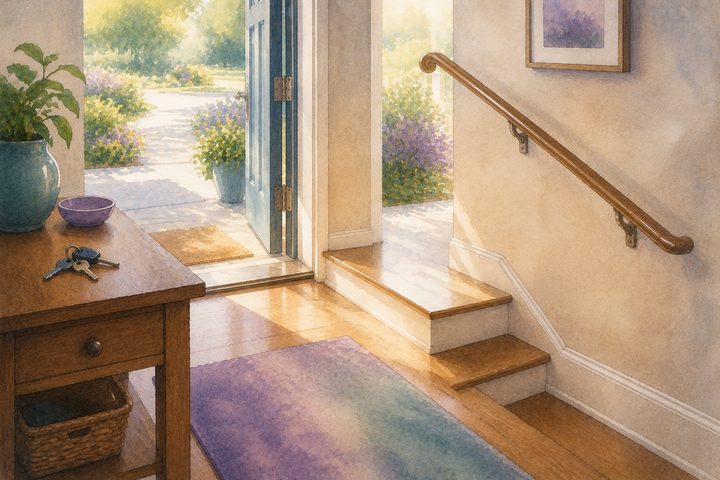
Look at the step or raised lip at the doorway. If it is high, your parent has to lift their foot more than they expect, and that is a classic trip. A small threshold ramp can smooth it out. The doormat just inside the door should grip the floor, not slide, the same non-slip rule once more.
Light and a place to set things down
Light the entry so your parent can see the threshold and the keyhole at night. A motion light outside the door helps too. Keep a small sturdy table or shelf just inside the door where they can set a bag down, so they are not carrying everything and fumbling for keys at the same time.
Outside steps and rails
If there are steps up to the door, they need a firm handrail just like the indoor stairs, and good light. Keep the path clear of leaves, ice, and clutter through the seasons. A clear, well-lit, well-railed entry is the last piece of a home your parent can move through with confidence.
What to do with your list now. Some of what you found in these two lessons you can fix yourself this week. Some, like mounting a grab bar into studs or adding an outdoor rail, is real work for a steady pair of hands. If you are a Basic or Pro family with an assigned advocate, message them with your list. The advocate owns the care plan and can note the pattern, and they can help you set up a home-help booking so a vetted provider does the heavier work. The family pays a small platform service fee for that booking, lower at the Basic and Pro tiers, and the provider keeps everything they earn for the job. Any tip you add goes to them in full.
When it is bigger than a home fix
A safer home prevents many falls, but not all of them. If your parent has already fallen, feels dizzy, is losing weight, or seems weaker or more confused than before, those are health matters. Write down what you have seen and bring it to their doctor or a physiotherapist. A physiotherapist can assess balance and strength and suggest exercises that a tidy room cannot replace. For an immediate emergency, the elder mobile app has an SOS button, and for a medical emergency you should always call emergency services.
Key takeaways for Lesson 2
- The bathroom, the stairs, and the entryway are where most home falls happen. Walk each one slowly and picture the real moment.
- In the bathroom, fit grab bars screwed into the wall beside the toilet and the bath, add non-slip surfaces, and offer a seat for showering. A towel rail is not a grab bar.
- On the stairs, a firm handrail (ideally on both sides), light at the top and bottom, and bright tape on each step edge prevent most stair falls.
- At the front door, smooth a high threshold, use a non-slip mat, light the entry, and keep outside steps clear and railed.
- For heavier work, message your advocate and set up a home-help booking. For dizziness, weakness, or a fall that already happened, bring it to the doctor or physiotherapist.
Finding this again Open Training from your family portal any time to come back to this module. This was Lesson 2 of two. There is a short self-check at the end if you would like to try it. The module is optional and educational, and nothing here is required.